“Generating itself in the oppressive situation and serving it, fatalism is nourished by the oppressors.”
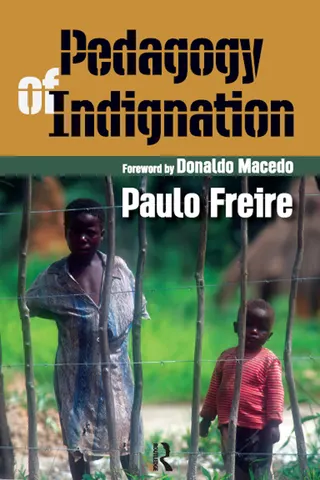
Quotes by Paulo Freire, each taken word for word from their books in the Ominira library.
“Generating itself in the oppressive situation and serving it, fatalism is nourished by the oppressors.”
“It is necessary that the weakness of the powerless is transformed into a force capable of announcing justice. For this to happen, a total denouncement of fatalism is necessary. We are transformative beings and not beings for accommodation.”
“If my presence in history is not neutral, I must accept its political nature as critically as possible.”
“Education, which must never be neutral, can be at the service either of decision, of world transformation and of critical insertion within the world, or of immobility and the possible permanence of unjust structures, of human beings’ settling for a reality seen as untouchable.”
“There is the duty, for example, to never, under any circumstances, accept or encourage fatalist positions.”
“The fatalism of the poor undeniably helps only the dominant.”
“It is because we can transform the world that we are with it and with others.”
“Education in the service of this lucrative combination obviously cannot have as its objective to reveal the alienating character of the process. What it must do, therefore, is to hide it, reducing education to the mere transference of know-how, seen as neutral.”
“The history of those colonized was thought to have begun with the civilizing presence of the colonizers. The culture of the colonized was a reflection of their barbaric way of seeing the world. Culture belonged only to the colonizers.”
“Divorced from the reality of the country, it was, for this very reason, a school for a minority, and thus against the majority.”
“Such “neutrality” serves as the foundation for reducing the education of a plumber to training in the techniques and procedures involved in wrench mastering.”
“The state should neither be an almighty entity nor a lackey that obeys the orders of those who live well.”
“The inherited colonial education had as one of its principal objectives the de-Africanization of nationals.”
“Amilcar affirmed that the middle-class intellectual needed the courage to commit class suicide before being reborn as a revolutionary worker, able to contribute to the struggle for liberation.”
“If, in reality, I am not in the world simply to adapt to it, but rather to transform it, and if it is not possible to change the world without a certain dream or vision for it, I must make use of every possibility there is not only to speak about my utopia, but also to engage in practices consistent with it.”
“No, my hope is necessary, but it is not enough. Alone, it does not win. But without it, my struggle will be weak and wobbly. We need critical hope the way a fish needs unpolluted water.”
“That is why there is no hope in sheer hopefulness. The hoped-for is not attained by dint of raw hoping. Just to hope is to hope in vain.”
“I am hopeful, not out of mere stubbornness, but out of an existential, concrete imperative.”
“When it becomes a program, hopelessness paralyzes us, immobilizes us. We succumb to fatalism, and then it becomes impossible to muster the strength we absolutely need for a fierce struggle that will re-create the world.”
“Reading the world is an antecedent act vis-à-vis the reading of the word.”
“Without a minimum of hope, we cannot so much as start the struggle. But without the struggle, hope, as an ontological need, dissipates, loses its bearings, and turns into hopelessness. And hopelessness can become tragic despair.”